Showing posts with label Paths. Show all posts

Monday, July 23, 2012

Some Thoughts About Indicating the Design of a Locomotor Path.

Submitted by DNB Staff - July 23, 2012

Recently I came across the “Video Aids” page on LODC USA.  This excellent resourse gives valuable ideas for teaching floor plans. 

The notation that accompanies the page contains an indication (shown here in Ex. a) for a zig-zag path. 

 
Drawing the design of a locomotor path inside a path sign is a novel idea I haven’t seen elsewhere. I think having a way to specify the path design on the staff (rather than on a floor plan) is useful.  I have another idea how it might be done.  Ex. b shows an established method of depicting a zig-zag design drawn by the arm.  Perhaps the same idea could be applied to locomotor movement, as in Ex. c. 

The use of the whole body pre-sign in Ex. c brings up another issue. In the LODCUSA notation, a path sign without a pre-sign, as in Ex. d, indicates a locomotor path (i.e., the trace form on the supporting surface produced when the whole body travels.) The LODCUSA notation doesn't depict a gestural path, but one could surmise that it would be shown with a body part pre-sign. as in Ex. e.

 If Ex. d indicates a locomotor path and Ex. e indicates a gestural path, how do you write that the body portion involvement is unspecified? In other words, the design of the path is the salient aspect. Whether the design is produced by the whole body or a body part is open to interpretation or irrelevant.
 
I feel a good solution is to have the indication without a pre-sign leave body portion involvement open (Ex. f).  Then locomotor paths can be indicated with a whole-body pre-sign (Ex. g), and gestural paths can be indicated with a body part pre-sign (Ex. h). The same idea can be applied to design drawing (Ex. i-k).
 
(For further explanation and examples of this approach, see Chapter VIII in Moving About, by Charlotte Wile with Ray Cook.)


Tuesday, January 26, 2010

Re: Questions About Turns and Paths, part 3

Re: Questions About Turns and Paths, part 3
Submitted by Ann Hutchinson Guest - March 26, 2007


[The following is a response to Fred Bolder's February 5, 2007 posting in the Turns, Revolutions, Rotations, Twists" thread.]

I don't know what book Fred Bolder was using, but certain things need filling in. I gathered that he is talking about ballroom dancing. I know that the DNB notators have replied to some extent to his Feb 5th questions, but I would like to add my comments.

1a. The foot will be placed forward (as this is the direction given) and, as the weight is transferred there will be a swivelling action.

1b. Because it is on a curved path, the foot will be placed diagonally forward left, part of the turning taking place on the right leg as the left moves into the step, the rest of the turn will be on the left foot, a blind turn, this because the leg will have turned outward as it takes the step so that it is back to the previous rotational state when the turn is finished. This automatic leg rotation is part of walking on a circular path, probably needs physical demonstration. Most ballroom people are unaware that they rotate the leg and follow it with a blind turn (non-swivel turn). Ex. 1e illustrates 1b.

1c. The convention has been that a very small vertical connecting bow means a total overlap of the two actions, therefore this is the same as 1a.

1d. The step starts without turning, then combines weight transfer and turning, then the turning continues after the weight is fully transferred. This is better illustrated with longer symbols.

2a. 1/4 of a circle on one step is rather a lot; this pattern is possible, but the sense of a circular path that is being followed is not present. If there is a change of Front, the step in place should have a turn sign, not a path sign.

2b. Here again there is an awful amount of circular path, I sense that this is a theoretical example, not a physical example. In any case it has long been established that when walking on circular paths, a step in place among directional steps does not include any change of front, thus 3/4 of a circle will need to be achieved on the first two steps, very uncomfortable.

[Following is a response to Fred Bolder's March 1, 2007 posting in the "Turns Revolutions, Rotations, Twists" thread.]

The example with four steps in place while making a full circle to the right has been considered by some as being acceptable because, in performing it, the feet have to rotate out and in as they step on a circular path, thus they will leave a very small circle on the floor. The feet do not actually step under each other, which, if done, would be closer to a swivel turn.

Ballroom Circling. When moving around the room anticlockwise, the understanding is either of one huge circle or of straight lines as one moves along the walls, and then a clear cut 1/4 turn as you turn the corner and follow the next wall. In the former the amount of turn needed to keep on this path is subsumed into the footwork and turning actions. This is why orientation according to the center of the room, the focal point, can be much easier to follow. Maria Szentpal was the expert on writing ballroom sequences.

Re: Questions About Turns and Paths, part 4

Re: Questions About Turns and Paths, part 4
Submitted by DNB Notators - March 26, 2007


The answer to your question about focal point indications can be found in Ann Hutchinson Guest, Labanotation, 4th edition, pp. 174-175; Muriel Topaz, Elementary Labanotation (1996), pp. 119-121, 130.

We would be curious to know which references you are using in your studies. A list of the books we usually recommend for people who are studying Labanotation can be found in "Studying Labanotation," located in the left side menu of the DNB web site.

You asked if there is a way to notate turns more easily in ballroom dance. Some people find using focal point indications easier, because they relate to places outside the body. But others prefer writing the total amount of turning during the steps.

Guest, Labanotation, contains further information about notating ballroom dance, e.g., page 382.

Re: Path signs and steps in place. Usually path signs should not be used with steps in place. However, as a convention, in certain situations the path sign can be used with steps in place, as in the example you give. Also, when notating a circular path, steps in place can be included if they are interspersed throughout the path, e.g., step, together, step, together, step. In your example 2b in your first posting, the step in place occurs at the end of the movement. Since that step in place does not contribute to the path, the path sign should end after the second step, as shown below. See pages 168-170 in Guest, Labanotation.


We are confused by your last question "Is it correct to notate multiple sequences like picture 2b...?" Do you mean repeat the 3 steps multiple times?

Re: Questions About Turns and Paths, part 2

Re: Questions About Turns and Paths, part 2
Submitted by Fred Bolder - March 1, 2007


Here is my response to the answers in the DNB notators' February 20, 2007 posting.

Thank you very much for the answers. Most things are clear to me now, but I am not sure if I fully understand the last example. I have no explanation of the big dot symbols, but I have seen those symbols before in a folk dance notation. Here is my description of the example.

You are standing with the left side of your body in the direction of the path. Step with your left foot forward (bend knees) and simultaneously turn left until you are facing the direction of the path, so the turn will be 1/4 + 1/6 to the left. Step with your right foot (on your toes) to the side and simultaneously turn right until you are facing against the direction of the path, so the turn will be 1/2 - 1/6 to the right. Step with your left foot to the side and simultaneously turn left until the left side of your body is in the direction of the path, so the turn will be 1/4 + 1/6 to the left. The end position related to the path is the same as the start position, so the sum of all turns should be 1/2 to the left.

1/4 + 1/6 - 1/2 + 1/6 + 1/4 + 1/6 = 3/6 = 1/2

Is all that correct?

I was a little confused by the answer: What is written in 2a and 2b is not possible as written because one cannot travel on a path when stepping in place (count 3).

In my book "Dance Studies Vol. 9, 1985" there is on page 42 the following example.
I have also seen examples with sideward movements along a circular path with the steps Side - Close (In place) - Side - Close (In place).

Do you have to travel during every step on a circular path?

Perhaps my book has some wrong examples or I misunderstand them, but it is hard to get 
Labanotation books in The Netherlands.

Addendum

[A couple of days after sending the previous posting, Fred sent the following addendum.]

I'm sorry, I have forgotten to write something in my previous response.

I now understand that my pictures 2a and 2b are very strange and it was not what I was trying to notate. The pictures 2a and 2b are different because on count 2 of picture 2a you step on a completely different path that is a sort of perpendicular to the previous path. I think that you don't turn on count 2 of picture 2b, because you have to follow the whole path and when there is no traveling in the direction of the path there is also no turn because of the path. I think that in picture 2b you are already at the end of the whole path after the first step, because you don't travel in the direction of the path on the counts 2 and 3 (you keep facing the line of the path). I think this is what you mean with your answer. I think that in picture 2b it has the same effect if you put the path symbol just over the first count. I was using the circular path symbol to indicate the total amount of turning during the three steps which is wrong, because you have to follow a path. I try to use Labanotation for ballroom dancing and for some turns it is sometimes easier and faster to read and write the only total amount of turning during the steps. Is there a way to notate this in Labanotation?

I suddenly realise that there is a mistake in my description of your example, because if I understand it well you don't travel in the direction of the path on count 2. That means that the path has no influence on the turn during that count and after the first step you are on half of the path. The turns should be:

Count 1: 1/4 L + 1/4 L(path)
Count 2: 1/2 R
Count 3: 1/4 L + 1/4 L(path)
(I assume that your example has three counts in one measure)


The sum of all turns is:
1/4 + 1/4 - 1/2 + 1/4 + 1/4 = 1/2


Is all that correct?

Just for my learning process:

Is it correct to notate multiple sequences like picture 2b (keep facing the line of the path) in one big circular path (instead of the drawn path) over all the sequences?

Questions About Turns and Paths

Questions About Turns and Paths
Submitted by Fred Bolder - February 5, 2007


I have started learning Labanotation and I have a few questions about turns and paths.

Does picture 1a means the same as picture 1b? If no, what is the difference?

Does the length of the vertical bows matter for the pictures 1a, 1c and 1d?

In other words:

1a. Stepping forward with simultaneous turning to the left. The step and turn start at the same time and they end at the same time.

1c. Stepping forward. The left turn starts just before the end of the step. The step ends just after the start of the turn.

1d. Stepping forward. The left turn starts halfway the step. The step ends halfway the turn.
Are the pictures 1a and 1b the correct way to notate 1e?

Does picture 2a mean the same as picture 2b? If no, what is the difference?

In circular path examples I have never seen both forward as well as side movements. Is picture 2b a correct notation?


Re: Questions About Turns and Paths, part 1

Re: Questions About Turns and Paths, part 1
Submitted by DNB notators - February 20, 2007


Following are answers to Fred Bolder's questions in his Feb 5, 2005 posting.

- Question: Does Ex. 1a in Fred's posting mean the same as Ex. 1b?

Answer: Ex. 1a is a pivot turn, stepping forward with swiveling. Ex. 1b indicates stepping onto the arc of a circle, as in 1e, with no swiveling.


- Question: Does the length of the vertical bows matter in Ex. 1a, 1c, and 1d?

Answer: Ex. 1a and 1c both indicate a full overlap of the turn and the step. However, while Ex. 1a is theoretically correct, the convention is to write as in 1c. Ex. 1c and 1d also have the same meaning, but 1c would be the preferred way to draw the indication.

- Question: Does Ex. 2a mean the same thing as Ex. 2b? Is 2b the correct way to indicate a circular path using forward as well as side movements?

Answer: What is written in 2a and 2b is not possible as written because one cannot travel on a path when stepping in place (count 3). In both examples there is insufficient information in the notation for what we think you are trying to convey.

One way to show a circular path produced with steps in different directions is shown below.


Friday, January 22, 2010

Diagonal Paths

Diagonal Paths
Submitted by Charlotte Wile - December 21, 2006

Indications for horizontal, somersault and cartwheel circular paths that relate to the dimensions, such as those in Ex. 1-3, are well established.

Signs for circular paths that relate to the diagonals are also needed. A suggestion for such indications is given in Ann Hutchinson Guest and Jouke Kolff, Advanced Labanotation: Spatial Variations, 2002, p. 256. The signs are shown here below. 
Ex. 4 indicates circling forward around the right-forward/left-backward diagonal. 
Ex. 5 indicates circling backward around the right-forward/left-backward diagonal. 
Ex. 6 circling forward around the left-forward/right-backward diagonal. 
Ex. 7 indicates circling backward around the left-forward/right-backward diagonal.

The path signs that relate to the dimensions all have generic indications, e.g., a clockwise or counterclockwise horizontal circular path (Ex. 8). I think it would be useful to also have generic indications for the diagonal circular path signs. For instance, Ex. 9 could indicate circling forward or backward around the right-forward/left backward diagonal, and Ex. 10 could indicate circling forward or backward around the left-forward/right-backward diagonal.


Circular Paths – New Symbology

Circular Paths – New Symbology
Submitted by Ann Hutchinson Guest and Charlotte Wile – June 29, 2004

The signs for circular paths are based on the signs for rotations: Ex. 1a is related to 1b; 1c is related to 1d; 1e is related to 1f, and so on.


Ex. 2a is the established sign for a somersault rotation either way, i.e. either forward or backward.

Logically the symbol for a somersault path (sagittal path) either way should be as Ex. 2b.

The previous decision for the sign for either somersault path was Ex. 2c. Because the symbol for any form of rotation is 2d, logically the symbol for any circular path should be 2e.


Re: Sign for Random, Meandering, Free Form Traveling

Re: Sign for Random, Meandering, Free From Traveling
Submitted by Ray Cook – November 25, 2002

The reason I love Labanotation is because most of the symbols are so visual in their representation. Ann’s new meandering sign, shown here in example 1, visually suggests a path to the right. I would suggest example 2 be used instead to give the impression of either right or left. Then the indication of other variations of the movement would be possible.


Sign for Random, Meandering, Free Form Traveling

Sign for Random, Meandering, Free Form Traveling
Submitted by Ann Hutchinson Guest - November 1, 2002

I believe that we all want to change the old sign for meandering, Ex. 1 here.

Of the ideas put forward and attempts at better signs, the following seems so far to have gained the most support, Ex. 2.

The new sign is a combination of the any path sign and an arrow indicating ‘going’, a progression. The arrow is used, of course, on floor plans with this meaning, but also in Labanotation as indicating the direction of progression. This seems an appropriate combination to serve as the sign for random, meandering, free form traveling, as the direction of progression is “any path”. This change will mean that the sign of Ex. 1 can mean curving, which so many people have wanted it to mean.


As you may know, I, together with Tina Curran and Jane Dulieu, are in the process of revising the book Your Move. This sign comes up in Chapter Two, hence there is an immediate need to achieve a decision which can go into the revised book.

Sign for Meandering

Sign for Meandering
Submitted by Ann Hutchinson Guest - June 3, 2002

Tina Curran, Jane Dilieu and I are embarking on the project of revising the Your Move book. We expect to get started quite soon as there is much to be adjusted. The teacher's notes are to be incorporated into the main book, etc. as wished by the publisher.

I feel we really must tackle the problem of a really appropriate sign for meandering. What we have now is makeshift, long standing, I know, but not right. My idea for it now is the 'any path' sign with a curlicue (like a pig's tail) at the end of the ad lib. sign on the right. This both at the bottom and at the top of the sign. (Ex. 1)

The present meandering sign with the half circle at top and bottom, would then be the 'curving' sign, that is curving without making or having in mind a circular path, i.e. the pull of a central focal point. The kind of curving which comes in waltzing. (Ex. 2) We would eliminate the sign we made up for curving which has the arrows added to the top right and bottom left. Perhaps the curving sign could have the arrows added to show if the curving is to the right (clockwise) or to the left (anticlockwise). (Ex. 3 and 4)


Indicating the Amount and/or the Size of a Path

Indicating the Amount and/or the Size of a Path
Submitted by Ray Cook and Charlotte Wile - November 9, 2001

Last summer at ICKL, Ann Guest presented a paper about the confusion that sometimes arises because measurement signs, such as those in Ex. 1 and Ex. 2 below, have various meanings. Her paper got us thinking about the use of those signs in path indications.

For instance, according to standard usage, Ex. 3 indicates 1/4 of a large circle; in other words, the measurement sign shows the size of the path design and the pin shows the amount of that design that is traveled on or traced. Ex. 4 just indicates an amount (size is not stated). Following this pattern, Ex. 5 just indicates a size (the amount is not stated).

In Ex. 3 and Ex. 4 the pin states a specific amount (1/4). How would one indicate a general amount, e.g., a relatively "large amount," or a relatively "small amount"? The measurement signs in Ex. 1 and Ex. 2 should not be used, because, as stated above, they are already used to indicate the size of the circle.


To deal with this issue, we suggest the following:

The amount of the path that is traveled or drawn could be indicated with a pin (to show specific amount) or a plain measurement sign (to show a general amount). (Ex. 6)

The size of the path design could be indicated with a measurement sign inside the sign for space, as in Ex. 7. This corresponds with the meaning of that sign inside a design drawing indication, as in Ex. 8.


Thus size and/or amount could be clearly and consistently stated, as illustrated below.


Ex. 9) any amount of any size circle
Ex. 10) small amount of any size circle
Ex. 11) any amount of a small size circle
Ex. 12) small amount of a small size circle
Ex. 13) small amount of a large size circle
Ex. 14) 1/4 of a small size circle
Ex. 15) any amount of any large size path


Question: How would this idea apply to straight paths? For instance, is there a difference between Ex. 16, which says to move a small amount (i.e., move a short distance) on a straight path, and Ex. 17, which says move on a straight path that is short in size? Could both modifiers be used, e.g., move a small amount of a long straight path Ex. 18?


Re: Meandering - A Few More Ideas, part 2

Re: Meandering - A Few More Ideas, part 2
Submitted by Charlotte Wile - April 25, 2000


I like Jimmyle's idea of using an Effort indication to denote the quality of a path.

Re: Her example, shown here as Ex. 1. The notation could be read as momentary Indirect Effort followed by a separate action. If the line following the Effort indication is supposed to be a duration line, perhaps a small curved bow should be added to the notation, as in Ex. 2.


Re: Meandering - A Few More Ideas, part 1

Re: Meandering - A Few More Ideas, part 1
Submitted by Jimmyle Listenbee - April 25, 2000


I have always thought the best way to notate the concept of "meandering" is to use the "any path" symbol modified by an "indirect effort action" symbol of equal duration. This expresses the idea that the path is motivated by a quality of inner attitude, which could include the objectives of looking around, searching, or wandering without any specific aim.


Meandering - A Few More Ideas

Meandering - A Few More Ideas
Submitted by Ray Cook - March 10, 2000


Following are further thoughts on the notes Charlotte Wile and I posted on Jan 7.

The trouble with Ann Guest's definition of meandering is that there are too many descriptions attached to the end result -- path.

Ann says in meandering there is "enjoyment."
I say this is not always true.


Ann says in meandering there is an "aimless quality."
Yet just above this Ann says, "as if looking for a lost object", which is not aimless.


Ann says, "It serves the mood of the wanderer."
I'm not sure what "IT" refers to. Does she mean the end result, i.e., the path?


All of this suggests to me that when you see a path that Ann is describing in words, you think that it must result from meandering, which may not be so.

Is walking with an aimless quality the same as meandering?

One can walk straight paths along the streets of NY with an aimless quality.

As far as I can remember, meandering referred to sluggish rivers that seemed to change their course for no reason, even though there was a geographical reason for so doing.

In Charlotte's description of traveling she writes that the mover "does not think about moving on a path."

This may be true but I THINK that what she wants to say is that he does not think about the path on which he moves - or maybe both the movement and the path.

Can't a choreographer give you specific movements to do to make you look as if you move with a meandering quality?

It always seems to go back to what is pedestrian and what the dancer/actor can make you think, i.e., the pedestrian may not be thinking, but the dancer is, because it is a conscious effort to make the movement not appear meandering.

In Ray's Comments (the last sentence), instead of saying "signs for the space beneath," it might be better to say "the support or surface beneath you."

Re: Traveling Indications

Re: Traveling Indications
Submitted by Ann Hutchinson Guest - February 10, 2000


I want to send a quick response to this, as I think help is at hand in quite another direction from that which you have been exploring.

First, I disagree with you that the sign for any form of traveling, A1, is tied so definitely to the path idea of traveling. I think this comes from the way it is taught. I try to de-emphasize the shape of the path idea, although drawing shapes of paths on the floor does help the very young child. More important is the sense of going, which, in time, leads to being aware of how you are going, which leads to finding the type of path taken.

Before I leave your paper, I am uncertain about how the shape of a triangle is a space indication. Is it some confusion connected with Design Drawing?

The Direction of the Progression (Direction of the Path). For dances such as the Farandole, Knust evolved the idea of using an arrow to indicate the `going'. The key is A2 here. The front signs which relate to the way this path is taking you are A3. You can see how these relate to our other Front Signs.

I think what you need is something like A4. Note that, while to arrow points forward in the key sign, it does not relate to the direction of travel. In writing the Direction of Progression (motion) for gestures, the motion is expressed by the direction symbol within which is placed a forward pointing arrow. As a convention, the arrow inside the appropriate direction symbol always points forward on the page, it is not tied to the direction or level of the motion which the direction symbol indicates.

How does this grab you?

The basic sign for traveling could be combined with this arrow, as in A5, if that would help solve your hesitation about what the sign of A1 means fundamentally.


Further Thoughts on Traveling Indications

Further Thoughts on Traveling Indications
Submitted by Charlotte Wile - February 25, 2000


Re: Ann Hutchinson Guest's Feb. 10 submission. I really like the idea of using an arrow for the indication of traveling (i.e., just "going," with the path irrelevant). I think it is the best solution so far. Ann's examples A4 and A5 ( Ex. 1 and Ex. 2 here) show two ways the arrow could be used to indicate such traveling. I like Ex. 2 best because it can be modified with distance, direction, and action signs, as shown in Ex. 3-5.


I think it might be useful to see how the proposed sign for traveling (Ex. 2) fits in with other indications for locomotion.

Paradigm 1 below contains standard path signs (Guest, Your Move, 1995, p. 25) and the proposed sign for traveling.


Looking at Paradigm 1, I think the proposed sign for traveling works well. However, I think the standard sign for meandering (Ex. 6 below) is confusing because it looks like it should indicate a curved path. One solution to this problem was discussed in The Labanotator, no. 75 (April, 1994). The sign for meandering could be drawn as shown in Ex. 7. Then Ex. 6 could be used to indicate a curved path.

Also, I would like to suggest that the standard sign for a path that is straight or curved (Ex. 8) could be changed to Ex. 9. Similarly, the standard sign for a path that is straight and curved (Ex. 10) could be changed to Ex. 11.


These new ideas are shown in Paradigm 2 below. Suggested changes are labeled "NEW".


Traveling Indications


Traveling Indications
Submitted by Ray Cook and Charlotte Wile - January 7, 2000


We have been discussing some ideas for generic traveling. indications Following are notes on that discussion.

CHARLOTTE'S COMMENTS:

I am interested in developing an indication that just says "travel." In other words, the salient aspect of the movement is that it travels through space; the path of the movement is irrelevant. For instance, the structure of a movement sequence might contrast traveling with movement in place (e.g., travel, then move in place, then travel again). For the traveling portions of the sequence, the mover just focuses on locomotion. He doesn't think about moving on a path.

Question: Could this idea be depicted with the indication for "meandering"? I don't think so.

Ann Hutchinson Guest describes meandering as follows:
"Meandering paths usually result from a state of mind in which travelling is not planned; there is just the enjoyment of 'going'. It may be a general looking around (perhaps searching for a lost object?) or indulging in a general aimless moving through space. Such meandering may include some straight path travel, but this is not the intention; there is a general aimless quality. It serves the mood of the wanderer." (Your Move, third printing with corrections, 1995, p.21)
According to this definition, meandering has an aimless, wondering quality. In contrast, the sign I am interested in would not denote a specific quality; it would just say "travel."

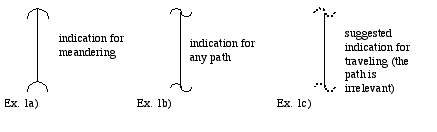
Also, the sign for meandering contains curves that I think suggest a curved path. (Ex. 1a) I would like a sign that does not evoke a specific path design.

Maybe the sign I want could be similar to the sign for "any path" (Ex. 1b), except the wavy lines in the proposed sign would be dashed (Ex. 1c). Note that the straight line in Ex. 1c is not dashed, because that would indicate passive traveling.


RAY'S COMMENTS:

You just want to say "travel." Therefore you need

1. A symbol without direction
2. A symbol that indicates a surface on which to travel.


You could use an action stroke and a space indication. (Ex. 2a-e)


What else is there?

You could add a support bow as a support, or a sign for the space beneath you. (Ex. 3a-h).