Thursday, August 13, 2026

Hartford Ballet School Workbooks: Learning Ballet Through Labanotation

Submitted by Mei-Chen Lu -- August 13, 2026

We are pleased to share, with permission from Enid Lynn, a set of four Hartford Ballet School Workbooks, created for young ballet students beginning their study of dance. 

The workbooks are particularly notable for incorporating Labanotation into the process of learning ballet. Rather than introducing notation only to advanced dancers, the Hartford Ballet School used it as part of the education of children, approximately 8 to 12 years old. The project was initiated by Enid Lynn, Director of the School of the Hartford Ballet. After studying at the Sigurd Leeder School in Germany in 1970, Lynn became intrigued by the concept of literacy through Labanotation. Working with Jill Beck, Judy Coopersmith, and her colleague Diane Fleming, Lynn developed four ballet workbooks incorporating Labanotation in the 1980s. Teachers used the workbooks alongside their ballet classes as students learned new steps and dances.

The project reflects an important idea: dance notation can be part of learning to dance, not simply a method for recording choreography after the fact. By connecting the written notation with the child's physical experience, the Hartford Ballet School introduced young dancers to the possibility of reading and understanding movement.

These workbooks provide a fascinating example of an early effort to develop dance literacy through Labanotation.


For more background and history on these workbooks, Ambre Emory-Maier wrote a fascinating article about the project.  

Acknowledgements

Our sincere thanks to Enid Lynn for granting permission to share these historic workbooks; Ambre Emory-Maier for arranging access and permission; and Valarie Williams and her graduate associates at the DNB Extension Center for Education and Research at The Ohio State University for scanning Workbook 2, Part 2. 

The materials are shared for personal study and research.


Monday, July 13, 2026

Changes and New Developments in Labanotation

Submitted by Mei-Chen Lu -- July 13, 2026

Changes and New Developments in Labanotation (1966)
Edited by Muriel Topaz

This publication documents an important stage in the evolution of Labanotation. In her introduction, Topaz observed that twenty-five years of practical application had expanded practitioners’ understanding of the system and its expressive possibilities. She emphasized that, like any language, Labanotation must continue to evolve: “no language can remain static—it must grow and flourish in order to continue as a viable form of communication.”

The revisions presented in this volume emerged through careful study and discussion among American and European Labanotation practitioners, particularly during international conferences. Intended to improve precision and consistency in the description of movement, these developments represented an evolutionary refinement of the notation system rather than a departure from its established principles. Topaz also stressed the importance of incorporating these revisions into future editions of the standard Labanotation texts to promote an internationally unified notation practice.

As part of the Dance Notation Bureau’s ongoing efforts to preserve and provide access to historical notation resources, we are pleased to share this significant publication with the Labanotation community.

Wednesday, July 30, 2025

Dancing Calgon: Embodied Research through Motif Notation

Submitted by Teresa Heiland -- July 30, 2025

In an embodiment study led by Dance Professor Teresa Heiland, her students Mandi Taylor, Marlene Jensen, and Stephanie Morikawa at Loyola Marymount University in CA explored how Motif Notation supports the process of learning dance from video. Through notating, revising, and performing, the dancers discovered how score writing deepens both intellectual understanding and physical embodiment. Their experiences highlight how Motif Notation can enhance cognitive, emotional, and kinesthetic learning—positioning the dancer as a researcher actively engaged in meaning-making and embodied inquiry.

This study was published at the Journal of Embodied Research in 2023.  To view this study, please go to:

https://jer.openlibhums.org/article/id/8903/


Friday, January 19, 2024

Tap Dance by Sheila Marion

Submitted by Mei-Chen Lu -- January 19, 2024

Dive into the rhythmic world of tap dance with "Tap Dance: A Dictionary of Steps in Labanotation" by Sheila Marion, a remarkable publication from 1986.  Dr. Marion, an ICKL Fellow and Professor Emerita from the Ohio State University, draws on her early experiences in tap dancing, both in communities and professional musical theatre.  This dictionary serves as a valuable resource, aiming to identify and describe traditional tap dance steps and combinations using Labanotation. Detailed sequences and variations in timing and execution for different steps are provided, offering insights into common usage.

This digital copy, granted permission by Dr. Marion for personal study and use only, is a treasure trove for anyone passionate about tap dance or interested in Labanotation.  Grab the chance to explore the rich history and intricate moves of this timeless dance form. 


Friday, December 16, 2022

Albrecht Knust Dictionary of Kinetography Laban

Submitted by Mónika Lisztes -- December 16, 2022

Online adaption of Albrecht Knust's Dictionary of Kinetography Laban is now available at https://knustdictionary.com/

The ongoing project began in 2020.  Currently about 300 entries (out of 1000)  are available to view online for free.  The online dictionary is based on the 1979 edition published by MacDonald and Evans.  A video demonstrating the website functions can be viewed https://vimeo.com/780980050

Thanks to Anthony Lange, the copyright owner of Knust Dictionary.  More entires will be published online later.  The project is supported by the Centre national de la dance, ICKL, the Association Nationale des Notateurs du Mouvement and the Hungarian National Talent Programme.  

Please share your experience through the following form after tryouts of the website: https://forms.gle/KxbdwYavs3PJQh6k6


Monday, May 16, 2022

Dr. Ann Hutchinson Guest and Her Contributions to Labanotation in China

Submitted by Beijing Dance Academy -- May 16, 2022 

Chinese Text: Sharina, Zhang Jiayuan, Liu Huangkexin
English Text: edited by Mei-Chen Lu

On April 22, 2022, Beijing Dance Academy hosted an online webinar titled "’Dance +’ Academic Salon: Laban System and its Practice in China Series (舞蹈+学术沙龙:拉班理论体系及其中国实践系列).” The first series was devoted to "Dr. Ann Hutchinson Guest and her contributions to Labanotation in China." Dr. Ann Hutchinson Guest just passed away on April 9, 2022, at the age of 103.  The guest speakers included National First-Class Choreographer Luo Bingyu (罗秉钰); Lu Mei-Chen (卢玫蓁), Director of Library Services from the Dance Notation Bureau; Professor Ou Jianping (欧建平), Honorary Director, Researcher, master/doctoral/postdoctoral Advisor of the Dance Institute, the Graduate School of Chinese National Academy of Arts; and Wang Yunyu (王云幼), Distinguished Professor of Beijing Dance Academy. These four guest speakers shared their work and academic experiences with Ann, and cherished  memories with her.  Ann was a scholar who made important contributions to the dance field. A large number of online participants attended the webinar and many of them left enthusiastic comments, which created a good academic atmosphere.

  The organizer, Professor Wen Rou (温柔), Dean of the School of Humanities and Director of the Dance Institute of Beijing Dance Academy, first expressed her sincere gratitude to the guest speakers.  She spoke of the idea of the “Dance + Academic Salon” and work practices in the field of research of the School of Humanities, Dance Science Research Center and Dance Institute of Beijing Dance Academy.  At the same time, she wished to spread and develop Laban system in China through the webinar series. Lastly, the Academic Salon was moderated by Dr. Sharina (莎日娜) of the Dance Institute of Beijing Dance Academy.


The organizer, Wen Rou


The moderator, Sharina


Ann Hutchinson Guest (L) and Luo Bingyu at 2013 ICKL Conference in Canada. Courtesy of Luo Bingyu.

    The first guest speaker, Luo Bingyu, shared "In Memory of the Mentor of Chinese Dance Notation - Ann Hutchinson Guest." Ms. Luo has devoted to the dissemination of Laban's theory in China.  Her related teaching materials are produced and will be published on the basis of the broad platform of Beijing Dance Academy. Ms. Luo gave vivid descriptions of Ann and her teaching to people who learned Labanotation in China. Moreover, she shared her experiences interacting with Ann. In 2008, Ann and Ms. Luo became acquainted with each other through her translation of Ann's Labanotation (4th Edition). During the following five-year correspondence, Ann always gave guidance to Ms. Luo and patiently provided explanations to her questions. Ms. Luo found the clerical errors in the published book and corrected them in a timely manner.  In 2013 at the 28th International Council of Kinetography Laban/Labanotation (ICKL) Conference in Canada, Ann spoke highly of the Labanotation Chinese translation completed by Ms. Luo. In Ms. Luo's narrative, Ann was not only a lovable and reliable mentor, but also a respected and beloved elder. Ms. Luo expressed her deepest condolences and remembrance of Ann's passing.


Sandra Aberkalns (Professional Notator, L), Ann Hutchinson Guest (Center), and Mei-Chen Lu in an outing in Summer 2020. Courtesy of Mei-Chen Lu.

    The second guest speaker, Lu Mei-Chen, Director of Library Services at the Dance Notation Bureau, shared "Dr. Ann Hutchinson Guest's Lifetime Research, Contributions and Books in Labanotation" by combining precious historical pictures and documents. Lu first stated Ann's important contributions to Labanotation.  Ann began learning dance notation at the age of 16 and devoted herself to the career of dance notation. Ann was an important figure in the implementation and development of Labanotation theory. Ann published more than 45 books about dance notation, recorded 60 dance scores, and compiled many teaching materials of dance notation. Her Labanotation (4th Edition) is an essential textbook for learners of Labanotation all over the world. Until two months before her passing, Ann's latest theory book Advanced Labanotation Book 10: Body Variations was just released.  Furthermore, Ann planned to finish writing the last two Motif Notation books for children and to attend ICKL conference in Hungary this summer.

    Lu shared some of the dance scores recorded by Ann. The Green Table, a work choreographed by Kurt Jooss, was first recorded in 1939 and published in 2003; The Shakers, choreographed by Doris Humphrey, was recorded in 1948. In addition, she shared a very meaningful event in Ann's notation career. In 1952, Ann’s Labanotation score Kiss Me, Kate (choreographed by Hanya Holm) obtained the first copyright in the drama category at the Library of Congress Copyright Office.  It began the new era of copyright works for dance.  It was an exciting event for all choreographers, which meant that dance notation became a fixed medium recognized by the Library of Congress Copyright Office in addition to films. In another event, Nijinsky's Afternoon of a Faun score was donated to British Library, but no one could read it.  Ann and her colleague decoded Nijinsky’s notation and successfully translated it into Labanotation. She later published Faune Restored.  This case is known as "the highlight moment in Ann's Labanotation career". Lu stated that besides Rudolf Laban's contribution to dance notation, Ann also made significant contribution to Labanotation research, practice and writing of dance notation textbooks. At the end of her speech, Lu reminisced about her contacts with Ann, and expressed her endless memory and fondness to Ann.

Ou Jianping accompanied Ann Hutchinson Guest to visit Dr. Sun Yatsen Mausoleum in Nanjing in 1988. Courtesy of Ou Jianping.

  The third guest speaker, Professor Ou Jianping, shared "The Charm of the Chief Authority of Labanotation: Ann Hutchinson Guest I Knew". Professor Ou reviewed several exchanges between himself and Ann: the 1988 Nanjing International Conference for Coordination Method Dance Notation; the Fifth Hong Kong International Dance Conference at Hong Kong Performing Arts Academy in 1990; and the two ICKL conferences held at Beijing Normal University in 2004 and 2017, and so on. Professor Ou's warm and sincere feelings moved every attendee.

   Professor Ou recalled that at the 1988 Nanjing International Conference for Coordination Method Dance Notation, he was greatly impressed by Ann's sincerity and modesty. Ann politely pointed out that at that time people in China did not have a thorough understanding of various contemporary dance notation systems, and the notation research was relatively superficial.  She humbly said that her studies in dance notation from other countries were also insufficient, and she still needed to continue her studies. She hoped that everyone could communicate more and learn from each other. At the Fifth Hong Kong International Dance Conference in July 1990, Professor Ou was impressed by Ann's analytical thinking. She argued that even the same dance movement should be able to record and analyze differently.  She pointed out that the weakness of Labanotation is actually its strength. When Ann attended the ICKL Conference in Beijing in 2017, she was nearly 100 years old. And yet she attended the whole meeting with high concentration and spoke actively. She talked in detail the story that Mr. Laban entrusted her to spread Labanotation. In the eyes of Professor Ou, Ann was a dancer with humanities and love. Professor Ou also condensed these experiences and feelings into a long text that will be published soon to express his infinite admiration and nostalgia for Ann. 
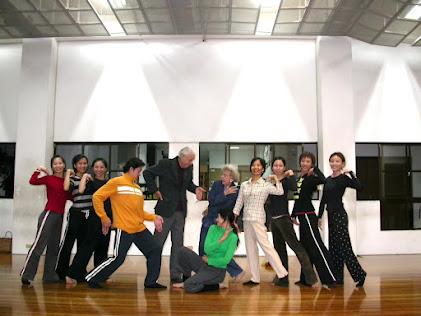

Ann Hutchinson Guest (center, and her husband, Ivor Guest, next to her) coached Afternoon of a Faun in 2005.  The stager, 
Wang Yunyu (R4), stood next to Ann. Courtesy of Wang Yunyu.

The fourth speaker, Wang Yunyu, a Distinguished Professor of Beijing Dance Academy, shared her two working experiences with Ann Hutchinson Guest in Taipei, Taiwan in 2005 and in Colorado, USA a year later.  Her topic was "Sharing the Time of the Faune with Ann Hutchinson". Professor Wang recalled the story of rehearsing Afternoon of a Faun with Ann and showed photos. During rehearsals, Ann was very careful and paid attention to details while guiding the dancers. She not only explained to the dancers how to read Labanotation and clarify details and the meaning of movements, but she also described the relationship between dancers and use of space through Effort. When there weren’t enough information in notation, Ann would make small modifications to make the movement smoother. In addition, Ann also made a great deal in music. She would spend a lot of time explaining a music beat in relationship to movement and eye focus, which made dancers and students who rehearsed this work quite admire Ann. In addition, Professor Wang also showed us another side of Ann who loved to make fun. Ann would tell the main character "Faun" how to hang clothes, and other details and key points of the performance by fiddling with small models wearing costumes. She would also portray a frightened girl. Her exaggerated and lovely facial expressions always made everyone laugh, but also let the dancers have a greater understanding of the performance. On the day of the performance of Afternoon of a Faun, there were no empty seats in the theater. Ann also said that this 21-day trip brought her home full of memories. Lastly, Professor Wang expressed her memorial to Ann, and hoped that we could remember her kindness.

These four guest speakers shared their cooperation and learning experiences with Dr. Ann Hutchinson Guest in different areas, which greatly benefited the audience. In the subsequent exchange session, the speakers had an in-depth conversation around the theme and discussed Ann and her contributions from more aspects. Lu Mei-Chen clarified that Ann was not a direct disciple of Laban, but a disciple's disciple of Laban. Professor Ou Jianping said that this point is very important for us to understand the history of the development of Labanotation. Furthermore, Professor Wang Yunyu also introduced professor Liu Fengxue's use of Labanotation to record Vast Desert, Solitary Smoke Rise Straight Op. 115 (作品第115号:大漠孤烟直). Professor Liu Fengxue (刘凤学) trusts Labanotation very much and wants more of her works to be recorded in notation. The online audience asked questions after the guest speakers’ speeches and conversations. Lu Mei-Chen responded to the audience who wanted to know about the creation of Laban's Vom Tauwind und der Neuen Freude (Of the Spring Wind and the New Joy). In the end, Professor Zhang Suqin of Shanghai Theatre Academy spoke about the situation of communicating and working with Ann before her death. 

Through these four guest speakers’ conversations and sharing, allowing us to better understand Dr. Ann Hutchinson Guest, an important figure in the history of dance.  We learned her lifelong love in dance and her ardent expectation for Labanotation in China.


Wednesday, January 5, 2022

Readings in Modern Dance Volume 1

Submitted by Mei-Chen Lu -- January 5, 2022

Readings in Modern Dance was prepared for the Intermediate Labanotation Students and was published in 1974 by the Dance Notation Bureau.  The volume one consists of nine excerpts from Modern dance master works. The editors of the book stated: "Our hope is to provide a literature which while furnishing material or the practice of reading skills will at the same time engage technical and interpretive abilities."

The excerpts of modern dance in volume one are:

  • Variations From Day to Day (1957) by Norman Walker. Notation by Ray Cook, assisted by Barbara Katz, 1968.
  • Passacaglia and Fugue in C Minor (1938) by Doris Humphrey. Notation by Lucy Venable, assisted by Joan Gainer, 1955.
  • Negro Spirituals (1941) by Helen Tamiris. Notation by Lucy Venable, 1967.
  • The Beloved (1948) by Lester Horton. Notation by Ray Cook, 1971.
  • Screenplay (1966) by Job Sanders. Notation by Muriel Topaz, 1971.
  • Folksay (1942) by Sophie Maslow. Notation by K. Wright Dunkley, 1972.
  • Odes (1965) by Anna Sokolow. Notation by Muriel Topaz, 1971.
  • Going (1962) by Marion Scott. Notation by Barbara Katz and Stephanie Thomas, 1972.
  • Partita V in G Major (1942) by Doris Humphrey. Notation by Els Grelinger, 1950. 

Last but not the least, the DNB would like to acknowledge the kind support from Gill Wright Miller and Dension University for sponsoring the scanning service.  


Monday, December 13, 2021

Principal KIN Usages and Rules Differing from LAB Usages and Rules

Submitted by Raphaël Cottin and Mei-Chen Lu - December 13, 2021

Jacqueline Challet-Haas's paper "Principal 'KIN' Usages and Rules Differing from 'LAB' Usages and Rules" is now available online. This article was originally written for the 21st ICKL Conference in 1999. The whole article has been revised with some updates, new layouts and graphics in 2020.   Now it is available in English and French at Centre National dÉcriture du Mouvement en Cinétographie Laban website.  

Note on the April 2020 publication:

This Technical Paper, revised by Jacqueline Challet-Haas, Raphaël Cottin and Noëlle Simonet, has been copied as close as possible to the original, while harmonizing the typography. The kinetograms have been revised as well as certain reformulations which seemed to us to contribute to greater clarity. The original paper can be consulted on request in the CNEM archives, deposited at the library of the Centre National de la Danse in Pantin, France.


Monday, May 10, 2021

Chinese Folk Dances

Submitted by Mei-Chen Lu, May 10, 2021

Madame Dai Ailian played a vital role in modern Chinese dance development.  She was born in Trinidad and received her education in England.  During World War II, she returned to her motherland and along she brought with her was Laban's theory to China. The system and theory Laban and his pupils introduced had deeply influenced Mme. Dai’s choreography and teaching.  

In the 1980s, Mme. Dai and her students spent weeks in rural areas in China to learn ethnic folk dances from locals and preserved them in Labanotation.  Later  "Eight Tibetan Folk Dances", "Eight Yi Folk Dances", and "Eight Chinese Nationalities Folk Dances" were published.  These folk dances are simple but reflect the life of people and aesthetic sense from their own culture.  

May 10 is Mme. Dai's birthday.  Here is our tribute to her by sharing her notation scores with the permission from the National Ballet of China. 

To view these scores, click the links below: 

"Eight Tibetan Folk Dances", 

"Eight Yi Folk Dances", and 

"Eight Chinese Nationalities Folk Dances"


Tuesday, April 6, 2021

Notes From a Course in Correctives

Submitted by Mei-Chen Lu -- April 6, 2021.


Five lectures and accompanying movement exercises which constitute an introductory course in correctives given by Irmgard Bartenieff at the Dance Notation Bureau.

The five sessions include:

1. Corrective: Its History and Terminology,

2. The Lower Unit: Initiation from Center of Weight - Locomotion - Change of Level,

3. The Rotary Element in Movement,

4. The Upper Unit: Counterbalance - Exploration - Orientation - Manipulation - Communication, and

5. Breathing.

The file is too large to view online. To download the book, click here.

Wednesday, March 17, 2021

Four Adaptations of Effort Theory in Research and Teaching

Submitted by Mei-Chen Lu -- March 17, 2021

Four Adaptations of Effort Theory in Research and Teaching by Irmgard Bartenieff, Martha Davis, and Forrestine Paulay.

Cecily Dell in the introduction stated:

"The four essays were originally lectures given in a seminar at the Dance Notation Bureau in 1968.  The authors collaborated in forming the first training program in Effort-Shape in the United States in 1965.  They have since become researchers and teachers in more specialized applications of Effort-Shape, and these essays reflect their current work.

The first essay explores the roots of Effort-Shape in Laban's early writings, while the second examines the theory in terms of its logic and consistency for scientific investigation.  The other two essays describe particular applications of Effort-Shape: one in movement training and re-training, and the other in cross-cultural movement research (choreometrics)."

To view the book online or download it:

https://drive.google.com/file/d/0B8Q3wiYtY7OCakM4TFQ3QTdXRUU/view?usp=sharing


Monday, March 8, 2021

Jazz Collections

 Submitted by Mei-Chen Lu -- March 8, 2021

Jazz Collection

  • Exercises and Jazz Combinations by Walter Nicks (1963). Notated by Muriel Topaz and Allan Miles.
  • Introduction to Modern Jazz by Peter Gennaro (1961). Notated by Jennifer Scanlon and Billie Mahoney.
  • Modern Jazz Combinations by Billie Mahoney (1963). Notated by Muriel Topaz and Allan Miles.
  • The Twist by Chubby Checker (1962). Notated by Allan Miles, Carl Wolz, and Billie Mahoney.

    Lyric Jazz Dances by Rose Lorenz, no date (1980s?):

    • True Love.
    • Frankie and Johnny.
    • Alley Cat.
    • Sophisticated Swing.
    • Golden Slippers.
    • The Hustle.
    • Taurus.
    • Ring Dem Bells.

    Modern Jazz New York Notation by Svea Becker and Laurie Winn (1975-1981). Edited by Ray Cook (1983)
    • Foreword
    • A Definition of Modern Jazz Dance
    • Footnotes and Music
    • Glossary
    • Jazz Terms
    • Notated Combinations
    • Index of Labanotation Terminology

    Variations on a Jazz Technique by Alvin Ailey (1965): 
    • Head Exercises. Notated by Ray Cook.
    • Chest and Shoulder Exercises. Notated by Ray Cook.
    • Short Movement Phrases. Notated by Ray Cook.
    • Dance Phrase from "Rocka My Soul". Notated by Ray Cook.
    • Dance Phrase from "Chain Gang". Notated by Ray Cook.
    • Lindy Phrase from "Blues Suite". Notated by Ray Cook.
    • Introduction to Tap Dancing by Paul Draper (1961). Notated by Ray Cook, Billie Mahoney, Lucy Venable, and Carl Wolz.
    • Introduction to Modern Jazz by Peter Gennaro (1961). Notated by Jennifer Scanlon and Billie Mahoney.
    • Modern Jazz Combinations by Billie Mahoney (1963). Notated by Muriel Topaz and Allan Miles.
    • Exercises and Jazz Combinations by Walter Nicks (1963). Notated by Muriel Topaz and Allan Miles.


    Monday, February 22, 2021

    Better Dancing with Fred Astaire

    Submitted by Mei-Chen Lu -- February 22, 2021

    Better Dancing with Fred Astaire was published in 1957.  Twelve Popular Dance Routines were styled by the Fred Astaire Dance Studio, including Fox Trot, Rhumba, Mambo, Tango, Samba, Cha cha cha, and Waltz. Labanotation was by Ann Hutchinson, word description by Edwin J. Sims, and music arranged by William C. Schoenfeld.

    The file might be too large to preview online. We recommend you to download the file. 


    Tuesday, February 16, 2021

    A Primer for Dance by Ann Hutchinson

    Submitted by Mei-Chen Lu -- February 16, 2021

    A Primer for Dance was the first in a series presenting Labanotation in a manner understandable to student and teacher alike.  Ann Hutchinson introduced "The Language of Dance" through Labanotation to teach fundamentals of movement and the traditional steps on which all styles and dance forms are built.   The materials presented here are a selection of established forms rather than movements of a personal invention.  

    The book includes cut-out symbols, the characters Peggy and Pete who guide you to read and write dance notation, and music scores.  

    The illustrations are by Doug Anderson, the music is by Julia Aerts.  A Primer for Dance was published in 1958.

    Please note the original book is wider than our scanner can accommodate, so some parts might be missing in the scanned version.  

    Friday, February 12, 2021

    Effort Observation and Effort Assessment in Rehabilitation

    Submitted by Mei-Chen Lu -- February 12, 2021

    This is a transcription from a lecture given by Irmgard Bartenieff on June 11, 1962 at the National Notation Conference, sponsored by the Dance Notation Bureau.


    Wednesday, January 23, 2019

    LOD and Tea - an YouTube Channel for Motif Notation

    Submitted by Mei-Chen Lu -- January 31, 2019

    Beth Megill, a certified Language of Dance® specialist, hosts LOD and Tea, an YouTube Channel discussing Motif Notation and Language of Dance® (LOD) concepts for dancers, choreographers, and other movement artists. Beth continues to add new clips to her channel periodically. In each video she emphasizes one topic only. It is fairly short, four to six minutes per clip. You can subscribe to her channel here:

    https://www.youtube.com/channel/UCvSfcmPzQ3DVeQrm3mvx4ow/featured

    Each video features different topic (listed by uploading date):


    Tuesday, January 22, 2019

    Chinese Edition - Elementary Labanotation: A Study Guide 初级拉班舞谱学习指引

    Submitted by Mei-Chen Lu -- January 22nd, 2019

    Wendy Chu (朱孟青), a dance lecturer of Hong Kong Academy for Performing Arts, undertook the challenge of translating the Elementary Labanotation Study Guide into Chinese.  The book was written by Muriel Topaz and published by the Dance Notation Bureau in 1996.  This textbook is used for the Elementary Labanotation Course in addition to Ann Hutchinson Guest's Labanotation.

    The translation project began in 2000 when Tom Brown, then chairman of the Hong Kong Dance Alliance, applied for funding to translate the Study Guide into Chinese. Wendy Chu stepped up since she was already teaching Labanotation in Chinese, and began translating the content on her own time.  Chu used her students for feedback, giving them one chapter at a time and making necessary changes based on their comments. Rayuan Tseng (曾瑞媛), Chu's classmate from The Ohio State University graduate school, also used Chu's translation in the early stage and provided her with additional feedback and changes.

    The Chinese Edition is available to download for free (or with a donation) at:

    https://labanotationchinese.wixsite.com/trad


    Thursday, October 11, 2018

    Mobiles Inspired by Labanotation Symbols

    Submitted by Jordan Isadore and Mei-Chen Lu -- October 11, 2018.

    Jordan Isadore is a dancer/choreographer originally from Northern California. He received his B.F.A. in Dance from California State University Long Beach in 2009. Upon relocating to New York, Isadore has worked with choreographers Alexandra Pirici, Christopher Williams, Andrea Miller, Sydney Skybetter, and Jennifer Edwards.  Most recently he’s worked with Shen Wei Dance Arts, and has performed at the David H. Koch Theater, Mariinsky Theater, throughout China, South America and Europe. His own work has been presented at The Museum of Arts & Design, 92nd Street Y, Joe’s Pub, Madame Tussauds, and The American Dance Festival. 

    Reimagining movement through mobiles. Taking dance movement that has been recorded using Labanotation, he returns these movements to their kinetic roots through mobiles made of stained glass and mixed metals. As a trained dancer he was introduced to Labanotation in college and instantly had an infatuation with it, however placed it aside as he focused on a career as performer. Now that he is planing his retirement from performing he started to investigate his other interests, most of which are design, home decor, and crafting. When he was looking at current trends in home decor and design he noticed that everything was leaning towards minimalist geometric shapes, all he could see was Labanotation. He loved the idea of notating three-dimensional movement, and the two-dimensional notations that are produced. He interpret these two-dimensional symbols into three-dimensional objects and suspend them into space. The movement of the mobile generates glimmers of the original notation, while creating new dances with each rotation.


    Friday, June 15, 2018

    Legal Problems regarding DNB publications

    Submitted by Ann Hutchinson Guest - June 15, 2018

    Legal Problems

    Following John Martin’s announcement on the forming of the Dance Notation Bureau we had a letter from Universal Publishers stating that we must in no way infringe on their copyright.  The background to this was the experience that Irma Bartenieff and Irma Betz had in 1937 in publishing their book of Studies in Laban’s Dance Script.  They were not allowed to give any explanation on the meaning of the symbols, that information was given as a leaflet insertion with Universal Publishers’ copyright.

    In 1940 we replied that our activities did not infringe on their copyright.  This limitation did pose problems for publishing a textbook in the future.   We sought information from Laban but he was unable to help.  All that our investigations produced was the strange information that the copyright had been requisitioned by the American Army when in Vienna after the war and then resided in Washington D.C.  I fear that all correspondence concerning this no longer exists in the DNB files.  As with the letter from Ninette de Valois expressing interest in having Labanotation at the Royal Ballet School (a very valuable document) these documents may have been turfed out when Herb Kummel took over as director of the DNB, his attitude being that nothing of the past was of value.

    Because at that time a copyright extended for 27 years and then had to be renewed, in 1954 we were hoping that Laban would not be aware of this and the copyright would expire.  He did become aware of it and hastily put out a publication Principles of Dance and Movement Notation by Rudolf Laban.  It was so full of mistakes that it was rapidly withdrawn.  I happen to have two copies of this publication.  In it he stated:
    NOTICE
    This book is copyrighted in the United 
    States of America and in all countries
    signatory to the Berne Convention.  No
    part of it may be reproduce in English
    or in translation unless my written
    permission and that of my publisher has
    been obtained

                                     RUDOLF LABAN                
    N.B. The signs for the notation of chore-
    Graphic or other movements may, with due
    Acknowledgement, be freely used. – R.L.

    In 1956 Laban published a more impressive hard cover book with the same title published by Macdonald & Evans.  It contained the same notice as above.   In it we found signs and usages that were unfamiliar to us.  Laban considered it his system, he did not need to confer with anyone else.  However, in the early 1930s,  he had given the system to the world, he was no longer interested in developing it, nor did he establish a body to oversee its development.  Were it not for Albrecht Knust, who made it his life work, Sigurd Leeder and Ann Hutchinson with her colleagues at the Dance Notation Bureau, the system could well have died away.  More than once Laban was keen to take it all back.

    My first Labanotation textbook was published in 1954 by New Directions.  How did we cope with the copyright situation?  The copyright statement was as follows:

    Copyright 1954 by The Dance Notation Bureau, Inc.  “Alphabet of Basic  Symbols,” Copyright 1954 by Rudolf Laban. 

    At the back of the book these appendices were given: 

    Alphabet of Basic Symbols
    Copyright 1954 by Rudolf Laban

    Variations in the drawing of certain symbols as used by some European colleagues have been included in this alphabet in order to facilitate reading scores.  These have been marked “alternate version.”

    Following this came:

    Glossary of Supplementary Symbols which also gave alternate versions.

    In his 1958 Kinetography Laban publications Albrecht Knust  made similar statements.

    The 1970 edition of Labanotation, published by Theatre Arts Books gave the following:

    Copyright © 1954, 1970 by The Dance Notation Bureau, Inc.  “Alphabet of Basic Symbols” Copyright 1954 by Rudolf Laban.

    However, in the pages of Glossary of Symbols (page 499 on) there is no separation.
    For the enlarged 2005 edition it states: Copyright ©  2005 by Ann Hutchinson Guest.  The appendices include: A – Alternate Versions.  B – Old Versions.  C – Orthography and Autography.  D – Upper Body Movement.  E – Terminology.


    Compiled by Ann Hutchinson Guest on December 8th, 2016.